The Letter Before the Novel: Stories in Pieces
Learn how letters and other documents shape a fragmented story, control what readers know and make omissions alter the meaning of each new account.
Document-based storytelling works when each record changes what the reader believes about the last one. In a story told through letters, diaries, reports or messages, the gaps between pieces shape what can be inferred, when it becomes clear and whose account deserves trust.
The form is not simply a continuous narrative broken into smaller parcels. A document has a writer, a purpose and limits: its author may be addressing one person, recording only what a form asks for, or trying to make a particular version of events stick. Those limits give structure a visible presence.
Document-based storytelling makes the act of recording part of the plot
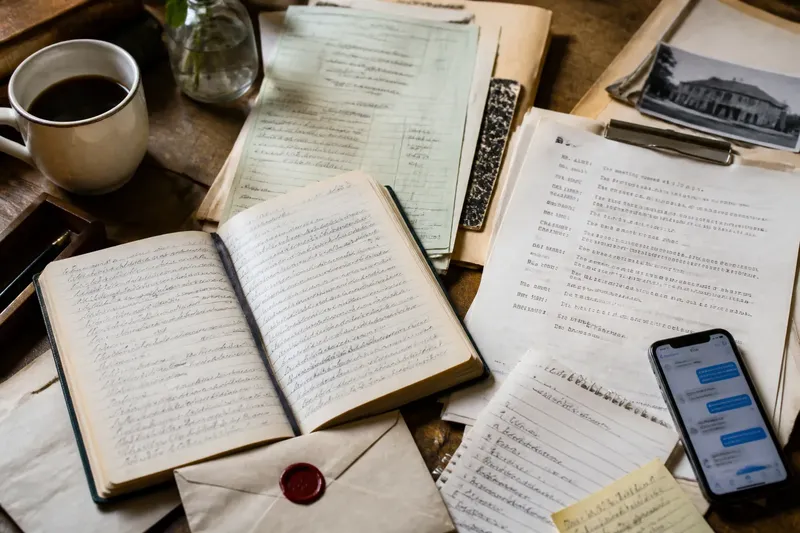
A document-based story presents events through materials produced within the story. Letters, diary entries, interviews, minutes, transcripts, emails and reports each offer a distinct kind of access. Instead of receiving one continuous account, readers compare records made for different reasons.
A letter may conceal a fact to spare its recipient. A diary can capture private impressions but not events its writer never witnessed. Minutes may record a decision while leaving the argument that produced it outside the frame. Each document supplies information and withholds something for a reason.
This differs from simply changing point of view between chapters. A close third-person scene can still present an organised account of an event. A collection of documents draws attention to who chose to record it, what seemed worth recording and what survived to be read.
Letters create pressure through a relationship
A letter has a sender and a recipient, even if the recipient never answers. That relationship gives the writer a reason to explain, persuade, confess, reassure or mislead. The distance between the two people can be geographical, emotional or social; the form does not need a long historical preface to make that tension work.
Letters can also make exposition feel like an attempt to affect someone. A writer describing a journey might be trying to reassure a worried relative. A reply can challenge the first account rather than merely add another instalment. The story advances through the pressure between the correspondents as well as through the events they describe.
For the writer, the useful question is not whether a letter sounds old-fashioned or convincing in isolation. It is whether this particular sender would write these things to this particular recipient at this point in the story. If the answer is no, the letter is probably carrying information for the reader that its supposed recipient does not need.
Document-based storytelling uses sequence to change interpretation
Sequence makes selection and omission part of the plot. A document arrives after another has established expectations; readers compare the two, revise an assumption and form a new explanation. That act of revision supplies momentum even when the records describe events that have already happened.
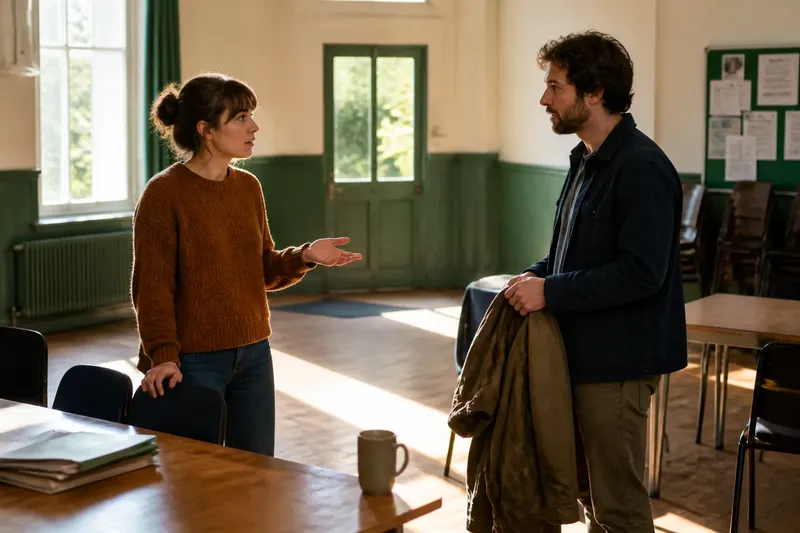
Imagine a story about a village hall closed after a disputed meeting. The first document is a caretaker’s incident report, which records the room and the time but says little about the argument. A later committee member’s note says a chair was missing before the meeting began. The starting record is therefore incomplete in a particular way; the later note changes how the reader interprets its tidy account. The missing chair becomes a question about what the report was designed to record, not merely an extra detail.
When planning the sequence, decide whether the reader should learn a fact before, during or after meeting an account that appears to contradict it. If every document supplies its information at once, the arrangement may be decorative rather than structural.
Coherence comes from a shared pressure, not a shared voice
A dispute, disappearance, journey or public decision can give different records a common subject. Each piece also needs a local purpose: to request, record, defend, remember, accuse or correct. Those purposes help the reader understand why one document follows another.
Give each piece enough orientation to place it. A date, recipient, heading or reference to an earlier message can help, but labels should not carry all the narrative weight. The opening lines can establish the writer’s immediate concern before the larger pattern becomes clear.
Variety is not a licence for arbitrary inserts. A private diary, formal notice and transcript can differ in vocabulary because they serve different uses. If two documents repeat the same information without changing its meaning, one is probably unnecessary. If a piece adds no new fact, motive, bias or consequence, its attractive format is doing unpaid work.
Gaps and contradictions should have boundaries
Gaps invite inference; contradictions test it. A record may mention an absent letter, stop before a sensitive subject or describe an event in terms that clash with another account. Readers must distinguish what the story establishes from what a document’s author claims.
Useful uncertainty has boundaries. Readers might not know who moved an object, while understanding why that matters. They might disagree about a character’s motive while knowing which event is disputed. If the basic situation cannot be reconstructed, uncertainty becomes bookkeeping, a poor substitute for suspense.
Choose omissions that belong to the person or institution producing the record. A clerk may leave out a detail because the form has no place for it. A friend may avoid an awkward conversation in a letter meant to comfort. A damaged or withheld document can also create absence, but that absence should change what can be known rather than simply rescue the plot from an inconvenient question.
Choose documents for the knowledge they can carry
Different forms suit different kinds of information. Letters are strong at address and persuasion; diaries at private interpretation; minutes at official decisions and procedural omissions; transcripts at speech separated from its original setting. Messages can show delay and quick exchanges, while reports can reveal how institutions translate messy events into categories.
For a contemporary story, a file might combine a forwarded email, a calendar entry and a formal complaint. The calendar could establish that people were expected somewhere, the email could show responsibility being passed along, and the complaint could reveal which account has become official. Each record then has a separate job.
Before adding a document, ask what it lets the reader know, what its writer cannot know and why it appears at this point. If the answers are interchangeable with those for another record, combine or remove one.
What should you decide before drafting?
Who is collecting or preserving the documents?
An editor, relative, clerk or recipient may explain why the records exist together. The frame can be brief, but it should not promise a complete record if selection and loss matter to the story.
When does the reader learn that the record is incomplete?
Early notice lets readers treat absence as part of the design. Delayed notice can create a turn, provided earlier documents have not concealed the basic rules of the narrative.
How much should each document explain?
Give a document enough context to be legible and enough restraint to retain its character. A letter need not summarise the plot for a recipient who already knows it, and a report need not become a miniature chapter.
What changes when two accounts disagree?
A contradiction should alter an inference, a relationship or the reader’s sense of authority. If it changes nothing, the discrepancy is noise rather than structure.
Use a revision pass to test every document’s job
List the records in order and note each writer, immediate purpose, new information and effect on the reader’s understanding. Then read the sequence in order, checking whether each arrival changes the situation or sharpens a question.
- Check whether the document has a named or clearly implied writer; if not, add a cue that identifies its source, or remove it if its origin does not matter.
- Check whether its recipient or audience is clear; if not, add an address, heading or opening line that establishes who is meant to read it, or recast it as a record with a defined audience.
- Check what new fact the document contributes; if it repeats an earlier one without changing its meaning, combine the records, or cut the repetition.
- Check what the writer could actually know; if the document reports information beyond that person’s access, provide a credible source within the story, or narrow the account to what the writer observed.
- Check whether an omission has a reason tied to the writer or institution; if not, give the silence a specific motive or procedural cause, or restore the missing information.
- Check what changes in the reader’s interpretation after the document; if nothing changes, move it to a point where it alters an inference, or remove it.
- Check whether the document’s form suits its purpose; if a report reads like a private confession, revise its language to fit its institutional use, or choose a form that can carry that confession.
Say you have three invented records for a story about a disputed allotment boundary: a caretaker’s note, an email from a neighbour and a council inspection form. The note says a gate was closed on Monday but does not say who closed it. The neighbour’s email says the gate was already shut when they arrived, so it changes the first record from a simple observation into an incomplete timeline. The form records the boundary location but has no field for who moved the gate. In that order, the records establish the uncertainty and show why the official form cannot resolve it; if the story needs the identity of the person, another source or a different kind of evidence must appear.
Read transitions aloud as well. A document’s final line can leave a practical or emotional consequence that the next piece answers, disputes or ignores. The hand-off need not be dramatic; a change of subject can reveal avoidance if the reader can see who made it and what they were avoiding.
Document-based storytelling works when each record changes what the next one can mean. Keep the main search question in view: how does document-based storytelling shape what readers know? The answer lies in authorship, sequence and omission, with each piece earning its place by altering the reader’s account of the whole.