A Five-Sense Walk for Building a Setting
A five-sense walk for building a setting helps you collect precise, usable details and turn them into a scene without making the prose read like an inventory.
A five-sense walk for building a setting is most useful when it gives you a few details that change how a scene feels, not a notebook full of things the reader must inspect. Walk a familiar route with one question in mind: what would a character notice here that might affect what they do next? That question turns ordinary observation into material for fiction.
The exercise can be done in three ways. A full sensory pass collects sound, smell, touch, taste and sight; a focused pass follows one sense; and a character-led pass notices only what matters to a particular person. Each has a different use. The trick is to choose the approach before you set off, then decide what belongs on the page when you return.
Choose a walk that gives you useful friction
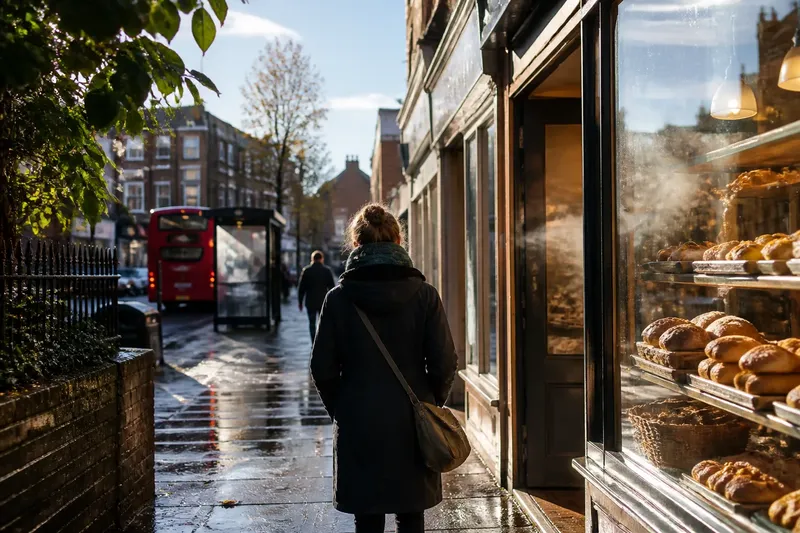
Pick a place you know well enough to move through without treating every corner as a discovery. A route to a bus stop, a row of shops, a park path or the shared entrance to a block of flats will do. Familiarity frees attention for small changes: a door left open, a patch of pavement that stays damp, or the sound of a delivery trolley before it comes into view.
Walk at an ordinary pace. You are not surveying the neighbourhood or collecting proof that the weather exists. Notice what catches, interrupts or redirects your attention. A bus braking at the junction may cover a conversation; a strong smell from a bakery may briefly make the street feel warmer than it is. Such details already contain a relationship between place and experience.
Before starting, choose a simple fictional question. Perhaps someone is trying to reach a particular doorway without being recognised, or waiting for a message that has not arrived. Keep the imagined circumstance modest. It gives your attention a direction without requiring you to invent a whole plot on the pavement.
The five-sense walk gathers breadth
A full sensory pass is a good choice when you can picture the location but cannot yet make it feel particular. Give each sense a brief turn. You need not record one item in every category, and some categories may offer nothing useful. The aim is range, not a completed form.
- Sight: Note a shape, movement, colour or quality of light that helps locate the scene. “Grey street” is broad; light caught in the scratched cover of a noticeboard is more situated.
- Sound: Listen for distance, interruption and rhythm. A lift motor stopping, a gate clicking shut or voices blurring behind a closed window can suggest what is near and what is withheld.
- Smell: Record where a smell seems to come from and how long it lingers. Wet leaves beside a drain have a different character from a trace of frying that follows someone through a doorway.
- Touch: Notice temperature, texture, pressure or air movement without handling anything unsafe or intrusive. A cold rail, grit under a shoe or wind funnelled between buildings gives the body a place in the scene.
- Taste: Do not taste objects or substances. If taste is relevant, note a safe, familiar sensation already present, such as the dry mouth that comes with waiting or the mint left by a sweet. If none arises, leave the category blank.
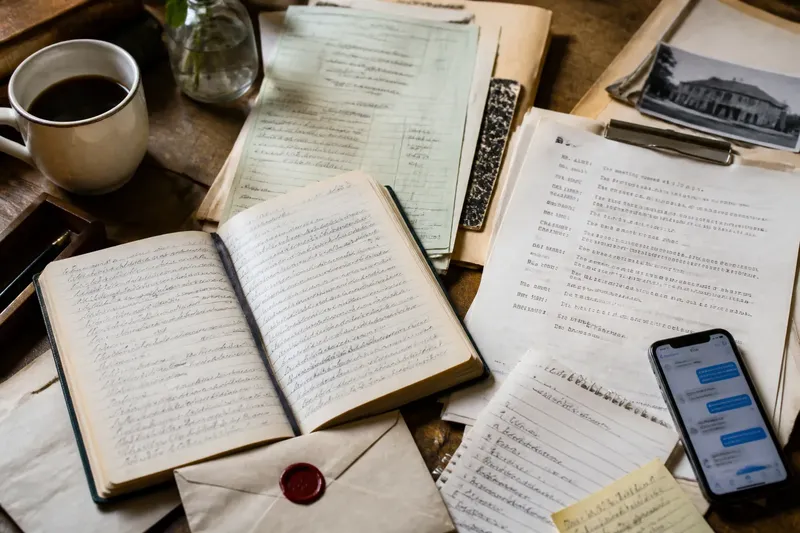
Write fragments rather than polished sentences. “Rattle, then silence” or “warm air at open shop door” is enough to prompt a scene later. Add a small mark beside a detail that altered your mood or attention. That response may matter more than whether the detail is unusual.
This broad approach suits an early draft when the setting still feels interchangeable. Its weakness is abundance: a page of five-sense notes can tempt you to display everything. Treat the notes as ingredients, not obligations. In the finished scene, one sound and one tactile detail may do more than a sentence naming all five senses.
A focused pass follows one sense more closely
Choose a focused pass when the setting is already clear in outline but feels thin, or when one sensory channel carries the scene’s mood. A quiet corridor, for instance, may be built chiefly through sound: the hum of a vending machine, a shoe scuffing on vinyl, a latch that does not catch. Adding smell and colour is possible, but not automatically helpful.
During the walk, follow that sense through changes rather than collecting a string of similar impressions. Ask where the sound begins, what blocks it, and what follows when it stops. For touch, notice how surfaces change from the rough brick of a boundary wall to the smooth push plate on a door. For smell, note whether it is local, passing or carried from elsewhere.
A focused pass suits a scene whose effect depends on a particular kind of attention: a character listening for someone, trying not to look directly at a person, or registering the cold because they have been outside too long. It also helps when prose has become crowded with sensory description. Restricting the walk gives you fewer notes and a clearer reason to use them.
There is a trade-off. A single sense can sharpen the scene, but it can also make the prose feel artificially selective if the character has no reason to attend to it. The restriction belongs to your drafting process, not necessarily to the finished passage. Keep the strongest observations and let the character’s immediate concern decide what reaches the reader.
A character-led pass filters the place through attention
Choose a character-led pass when you know whose point of view carries the scene and want the setting to reveal something about that person. The same bus shelter can be a place to escape rain, a useful mirror, a source of noise or a reminder of a missed appointment. The physical location has not changed. The character’s priorities have.
Walk the route while holding one practical concern in mind. What would this person seek, avoid, misread or use? Someone carrying a hot takeaway may notice gaps in the crowd and the tilt of the pavement. Someone hoping to remain unnoticed may register reflective shop windows and the moment a stranger turns their head. Do not write a biography for the walk; give the character one present-tense need and let that narrow the field.
This approach is especially useful when description sounds like the author stepping in to admire the scenery. A character-led detail has a reason to be noticed. That reason need not be explained. The description can quietly show that a person is hungry, wary, impatient or at home without naming the quality as a diagnosis.
Its risk is over-signalling. If every object neatly reflects the character’s feelings, the setting starts behaving like a very obedient metaphor. Keep some details indifferent. A bin still needs emptying when a character is heartbroken; that is part of the place, not a failure of symbolism.
Turn observations into scene material without listing them
After the walk, sort your notes by what they can do. A detail might orient the reader, interrupt an action, reveal a character’s attention, or alter the pace. If it does none of those things and does not make the place more distinct, it can stay in the notebook.
Imagine you have walked past a corner shop while picturing a character who wants to leave a conversation unnoticed. Your notes include a bell above the door, a cold metal handle and a delivery van blocking part of the pavement. You might use the bell when the character enters at the wrong moment, then let the van’s obstruction force them to pass close to the person they meant to avoid. The handle can be omitted. The setting now affects the action instead of appearing as a small catalogue.
Try three questions before keeping a note:
- Does it help the reader place the character in this particular location?
- Does it change what the character can perceive, feel or do?
- Can it be woven into action, rather than announced as scenery?
When several notes answer the same question, choose the one with the clearest effect. Two competing smells may be useful if their contrast matters; otherwise, one will usually carry the moment. A detail can also earn its place through timing. A distant siren is unremarkable until a character stops speaking to listen for it.
Use verbs that connect sensation to attention. A door can stick, a light can flatten a face, or a train can swallow the end of a sentence. These actions keep description in motion. Adjectives still have their place, but a pile of them tends to make the reader stand still while the setting is introduced.
Which five-sense walk suits your draft?
How long should a five-sense walk take?
Long enough to cover an ordinary stretch of familiar ground and notice what changes along it. Stop when your attention starts repeating the same kind of observation; another lap is not automatically another insight.
What if I cannot find anything interesting?
Look for a small interruption rather than an impressive landmark: a sound that cuts off, a surface that changes underfoot, or a smell that belongs to a nearby doorway. If nothing connects to the scene’s need, record little and choose a different route or question later.
Should every scene use all five senses?
No. A scene needs the details that support its point of view and movement, not a full sensory inventory. The five-sense walk is a way to collect options, not a requirement to use them all.
How do I avoid making the notes sound like description?
Write fragments in the notebook, then place only selected details beside an action or change in attention. If a sentence merely tells the reader that a place contains an object, ask what the character does with that information.
Choose the pass that matches the missing quality
Use the full five-sense pass when you need breadth, the focused pass when one sensory channel should shape the atmosphere, and the character-led pass when description needs to belong more clearly to a point of view. You can combine them, but begin with one so the walk has a purpose.
For a five-sense walk for building a setting, the most useful result is not a vivid notebook page. It is a small selection of details that could only matter in this place, to this character, at this moment. Keep the rest available. Fictional streets, like real ones, contain more than any visitor has reason to mention.